







From rule writing to rule review: How InfoBeans RDE™ (Rule Discovery Engine) helps banks trust their data

Every report you file rests on rules someone remembered to write. What about the ones nobody did?
AI has changed the pace of banking data. Pipelines refresh faster, models retrain more often, and regulatory reports draw on more sources than ever. Yet the layer that decides whether that data deserves trust, the data quality rule book, is still largely built by hand.
The result is a rule book that shows what has been checked, but rarely what has been missed. In banking data, what has been missed is usually where the next restatement begins.
The problem is bigger than a failed validation
Banking data quality has always run on predefined rules. Domain experts identify the business conditions that must hold, engineering teams translate them into executable validations, and analysts review the results.
The approach is familiar. The difficulty is keeping it comprehensive as the data landscape keeps changing. Three gaps stand in the way.
- Rules take time to build. Every new validation needs business expertise, engineering effort and testing before it protects anything.
- Connected data creates blind spots. Errors can hide in the relationships between tables, even when every individual record passes validation.
- Missing rules go unnoticed. Existing checks show what fails. They cannot show what the validation process has overlooked.
Introducing InfoBeans RDETM: from rule writing to rule review
Closing those gaps is the thinking behind the InfoBeans Rule Discovery Engine (InfoBeans RDETM).
InfoBeans RDETM is an AI-driven intelligence layer for banking data quality. It reads your linked datasets, the rules you already rely on and the context of your business. It then discovers the rules you are missing, proves each one against your real data and ranks them for your analysts to approve.
It brings together three inputs:
- Banking data: the interconnected datasets that need to be validated.
- Seed rules: established regulatory and business rules that give discovery a trusted starting point.
- Business context: a description of the business, its products and the conditions that matter in its data.
The outcome: a tested, scored and audit-ready rule set in minutes, with your experts approving every rule.
That changes the nature of the work. Analysts no longer write rules from a blank page and wait for engineering to code them. They start with a shortlist of rules that have already been coded, executed and scored, and spend their time on the decision only they can make: which rules reflect how the business really works.
InfoBeans RDETM at a glance
| Capability | What it does |
|---|---|
| Data profiling | Analyses data structure, distributions, missing values and the relationships between tables |
| AI-driven discovery | Proposes candidate rules from data profiles, seed rules and business context |
| Hybrid retrieval | Uses keyword and semantic search to ground every suggestion in existing rules |
| Automated execution | Converts candidate rules into runnable tests against the actual data |
| Rule evaluation | Scores candidates on support, coverage, specificity and lift |
| Human review | Lets analysts accept, reject or refine candidates |
| Traceable reporting | Documents accepted rules with their rationale, test code and results |
The key difference: InfoBeans RDETM does not ask analysts to trust what AI suggests. It gives them tested candidates and the evidence to make an informed decision.
Inside an InfoBeans RDETM run
Once the three inputs are in place, an orchestrated team of AI agents takes over. Two tracks run side by side: one tests your existing seed rules straight away, while the other discovers new ones.
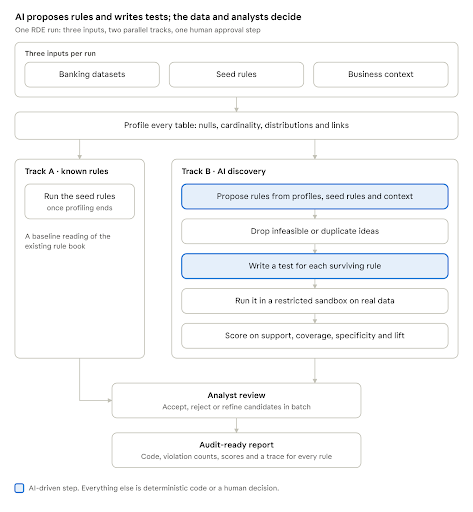
How a single InfoBeans RDETM run moves from three inputs to an audit-ready report
01. Profile the data
InfoBeans RDETM loads the selected tables and examines null rates, cardinality, distributions and sample records, building a clear picture of the data before discovery begins.
02. Hypothesise
An AI agent analyses the data profiles, the most relevant seed rules and the business context, then proposes candidate rules across the relevant categories.
03. Validate
Duplicate or infeasible ideas are filtered out before any test code is written.
04. Generate test code
Each surviving candidate is translated into an executable Python test backed by DuckDB.
05. Execute against the actual data
Tests run in a RestrictedPython sandbox against the selected dataset, and every violation is recorded.
06. Score the candidates
Each candidate is scored on support, coverage, specificity and lift, so analysts can focus on the strongest rules first.
07. Review with analysts
The workflow pauses for batch review. Analysts accept, reject or request refinements to the proposed rules.
08. Generate the report
Accepted rules are compiled into Markdown and JSON reports that include their rationale, test code, violation counts and quality scores.
AI where judgment is needed, deterministic code everywhere else. Anthropic’s Claude models propose rules and write their tests, grounded through Qdrant vector search and BM25 keyword search. LangGraph orchestrates the pipeline, including the pause for human review. Tests run in a RestrictedPython sandbox over DuckDB and pandas, scores are calculated from the data itself, and Langfuse traces every model call, prompt and output. The platform deploys on Azure with infrastructure as code, and for pilots the full stack starts on a laptop with a single command.
What changes for the teams doing the work?
Faster rule generation is only part of the value. InfoBeans RDETM also changes how the work is shared between data teams, engineers and domain experts.
| Activity | Conventional approach | With InfoBeans RDETM |
|---|---|---|
| Identifying potential rules | Experts manually identify the conditions to validate | AI agents analyse the data and propose additional candidates |
| Writing validation logic | Engineers translate each condition into code | InfoBeans RDETM generates executable test code for every candidate |
| Running tests | Teams implement and run checks through their existing process | InfoBeans RDETM runs generated tests in a controlled sandbox |
| Finding coverage gaps | Teams rely on existing rule libraries and manual investigation | Open-ended discovery explores new patterns and relationships |
| Prioritising rules | Reviewers weigh rules using available evidence and expertise | Candidates are scored on four dimensions to guide review |
| Reviewing results | Evidence is gathered across separate steps | One report brings together rules, test code, violation counts and scores |
| Maintaining validation | New requirements trigger more manual rule definition | Updated seed rules and business context feed the next discovery run |
Less repetitive rule engineering
Discovery, code generation and test execution are connected in one workflow. Engineers no longer start every candidate from a blank page and carry it manually through each step.
Broader validation coverage
The open-ended discovery track lets teams look beyond their existing rule library. This matters most for data relationships that single-table checks struggle to capture.
More focused expert involvement
Domain experts remain essential. Their role shifts from originating and translating every check to judging the quality and business relevance of the rules InfoBeans RDETM proposes.
Evidence behind every accepted rule
Reviewers can examine the test code, violation counts and quality scores behind each candidate, giving them a structured basis for deciding which rules to keep.
A clearer record for regulatory reporting
For banking teams working to expectations such as BCBS 239, being able to explain what was checked and why a rule was accepted matters. InfoBeans RDETM produces structured output that supports this review and documentation. It does not, by itself, establish regulatory compliance.
What the first runs showed
We demonstrated InfoBeans RDETM end to end on a realistic synthetic banking data model rather than a single isolated table: eight connected tables covering counterparties, instruments, books, product hierarchy, account classification, positions, position balances and journal entries. Every run moved through both tracks, scored each candidate on four dimensions and ended with human approval.
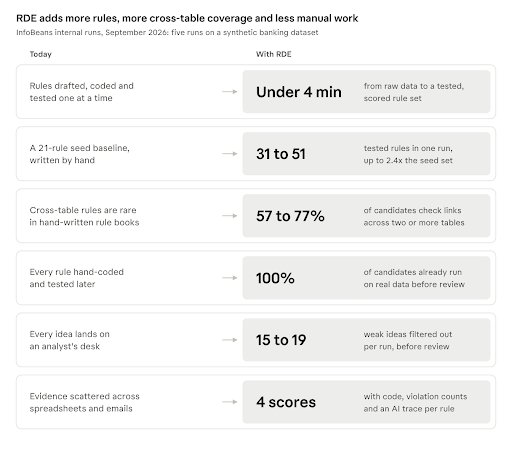
InfoBeans internal runs, September 2026, synthetic banking dataset
Where InfoBeans RDETM fits
BCBS 239 and risk data aggregation
Build tested completeness, accuracy and integrity rules across the risk data model, with evidence behind every control.
Stress testing and capital reporting
Prove the rules behind positions, balances and ledger data before the numbers go into a submission.
Rule book gap analysis
Load your existing rules as seeds and see, in a single run, which rules you are missing.
New products and datasets
Profile a new dataset and get its first tested rule set in minutes, so coverage starts on day one.
Make your rule book as fast as your data
Boards and supervisors are asking sharper questions about risk data: is it complete, is it accurate, and can you prove it? Too often, the honest answer rests on rules someone wrote by hand years ago.
We built the Rule Discovery Engine to change that answer. We have run it end to end on a full banking data model, and we are ready to run it side by side with your team.
Preparing for a BCBS 239 review, heading into a stress testing cycle, or simply want to know what your rule book is missing? Let’s talk about what it would take to run InfoBeans RDETM on your data.

Stay up to date with InfoBeans
Get insights from our team of experts who deliver digital software day in and day out.
 Thank you for signing up!
Thanks a lot for your interest. You are already a subscriber. You will receive your first newsletter soon.