







From headline to hedge: How our Early Warning Signal Hub (EWSH™) helps banks pre-empt counterparty risk

Risk metrics tell you where a counterparty stood. The news tells you where it is heading.
Somewhere in this morning’s news, a chief financial officer has resigned, a regulator has opened an inquiry, or a key supplier has missed a payment. For a bank with exposure to that company, each story is a possible shift in credit quality or market risk. Yet most risk frameworks register the change only later, once it surfaces in filings, rating actions or backward-looking regulatory metrics.
That delay has a price. A risk spotted early can be hedged, reduced or renegotiated on the bank’s terms. The same risk spotted late tends to be handled under pressure: hedges at worse prices, rushed position cuts, provisions taken after the damage is done, and harder conversations with the board and supervisors.
The InfoBeans Early Warning Signal Hub (EWSHTM) has been built to win back that time. It answers one question for every counterparty in the trading book, every day: does today’s news change our risk posture?
Why the news rarely reaches the risk desk in time
Banks are not short of information. What they lack is a way to turn it into decisions at the speed it arrives.
- Too much to read. Thousands of global news items break every day. Scanning them by hand cannot scale without adding significant analyst headcount.
- Too generic to act on. A negative headline is not a risk signal on its own. Its meaning depends on the size of the exposure, whether the bank is long or short, how healthy the collateral is, and whether the story concerns the counterparty itself or a distant supplier.
- Too late to matter. Ratings, disclosures and regulatory metrics describe the past, and they tend to move after the story has already broken.
Meet the Early Warning Signal Hub
EWSHTM is an end-to-end risk intelligence platform for wholesale banking. It follows financial news around the clock, uses natural language processing to understand each article, and then does what generic sentiment tools cannot: it weighs every story against the bank’s own positions, limits, credit quality and collateral.
Each relevant article produces two signals:
- Institutional Sentiment: how positive or negative the news is for this bank, given its actual exposure to the counterparty.
- Scaled Impact Score: how far that news could move the desk’s risk, measured against its risk capacity and tied to a clear next step.
The result: instead of reading everything, risk teams act on the few stories that could actually move their book, ranked by impact and backed by the reasoning behind every score.
What it means for the business
Earlier warning changes the economics of counterparty risk in five ways.
Decisions while there are still options. A story caught in the yellow band can be discussed, hedged or reduced on the bank’s terms. The same story discovered at red, or through a rating action weeks later, leaves fewer choices and more expensive ones.
Coverage that scales without adding headcount. In production, EWSHTM tracks 4,000 counterparties and scores around 1,000 articles a day. At just two minutes an article, reading that volume by hand would take more than 30 analyst hours every day, before anyone had worked out what it meant for the book.
Expert time spent where it pays. Impact ranking pushes background noise to the bottom of the feed, so credit and market risk specialists spend their day on the handful of names that could actually move their numbers.
Escalations everyone can stand behind. The same thresholds apply across desks, and every alert arrives with the calculation behind it. Desk heads, risk committees and model validators share one consistent, defensible view of what changed and why.
A stronger answer for supervisors. A documented layer of forward-looking, news-driven signals, with a full calculation trail behind every alert, gives the bank a far more convincing account of how it sees risk coming.
From headline to signal in four stages
How a news story becomes a bank-specific risk signal, and how analyst feedback flows back into the models
Stage 1: Listen
News is collected continuously from financial news APIs, wire feeds and RSS sources, deduplicated across sources and matched to counterparties. One article can map to several counterparties at once, so a story about a parent company reaches every exposure it touches. In production, entities are resolved against the bank’s portfolio using identifiers such as ISIN, LEI and known corporate aliases.
Stage 2: Understand
Each article is enriched with natural language processing. Named entities are extracted, low-signal content such as advertisements and off-topic pieces is filtered out, and the story is classified across 28 industry and macro sectors, from energy and technology to interest rates, credit spreads and geopolitical risk. A concise summary of up to 200 words is generated for every article.
Stage 3: Read the tone
FinBERT, a language model trained for financial text, reads each article in the context of its entities and assigns a sentiment label with a confidence score. Together they produce a generic sentiment score between −1 and +1. In production, phrasing the model finds ambiguous is routed automatically to an enterprise LLM for deeper analysis.
Stage 4: Weigh it against the book
This is where EWSHTM departs from off-the-shelf sentiment analysis. The generic score is joined with the bank’s reference data, including positions, limits, credit ratings and collateral, and converted into Institutional Sentiment and a Scaled Impact Score. The results flow to a live dashboard where officers can monitor counterparties, follow sentiment trends and open the full calculation behind any article.
Why the same headline means different things to different desks
Generic sentiment treats every reader the same. EWSHTM asks how much a story matters to this bank, through four lenses.
How big is the exposure? An exposure weight combines credit exposure against its limit, market risk (DV01) against its limit, the counterparty’s credit quality on a scale from AAA to CCC, and the health of its collateral cushion.
How close is the connection? A relationship factor scales the signal by how directly the story touches the counterparty.
| Relationship to the counterparty | Weight applied |
|---|---|
| The counterparty itself | 1.0 |
| Parent or guarantor | 0.7 |
| Subsidiary or sovereign | 0.6 |
| Joint venture | 0.5 |
| Major customer or key supplier | 0.4 |
| Peer institution | 0.2 |
How serious is the event? A severity multiplier amplifies events that warrant it, for example 2.5 times for a regulatory raid.
Which way is the bank positioned? If the bank is short rather than long, the direction of the signal flips.
Finally, the impact is measured against the desk’s own risk capacity using position stress (DV01, CS01 or delta under a stress shock), and every score falls into one of four action bands.
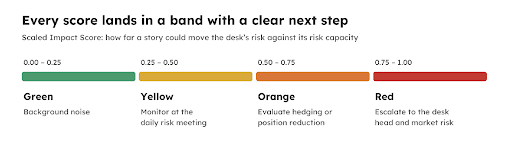
A story about a key supplier’s plant shutdown, for instance, could be background noise for one desk and an orange alert for another, purely because of how each is exposed.
Built to be questioned
In risk management, a score nobody can explain is a score nobody will act on. EWSHTM is designed so that every number can be traced and challenged.
- A full calculation trail. For any article, officers can see every intermediate value, from the raw FinBERT score to the final Institutional Sentiment and Scaled Impact Score.
- Documented model governance. The quantitative model is specified with its formulas, data lineage, worked examples and SR 11-7 model risk governance notes.
- Accuracy tracked over time. Golden evaluation datasets monitor precision, recall and drift.
- Bank-grade protection. TLS 1.2+ and 1.3 in transit, AES-256 encryption at rest, secrets held in a managed key vault, and lineage and access logs governed through Databricks Unity Catalog.
A model that learns from its analysts
Experts stay in the loop. On the evaluation screen, analysts can override the model’s summary, sector and sentiment rating for any article, and tune the coefficients that drive the exposure weight.
Those corrections become labelled training data. All four NLP models are retrained through Databricks MLflow, with every experiment tracked and every model version managed before it returns to production. Over time, the signals are designed to move closer to how the bank’s own experts read the news.
Where banks can put it to work
Protecting the credit book
Track every counterparty against live news and catch deteriorating names while there is still time to act on limits, collateral or pricing.
Getting ahead of market moves
Spot stories that stress rates, credit, equity or FX positions early enough to evaluate a hedge or trim exposure on the bank’s terms.
Sharper daily risk meetings
Use the yellow band as a ready-made agenda: the names worth discussing before they become problems.
Confidence with validators and supervisors
Show a transparent, documented model with a complete trail behind every signal, ready for model validation and supervisory review.
Pre-empt
Ratings and disclosures will always matter, but they arrive after the fact. The banks that act first are the ones that see the story first and know straight away what it means for their book.
The Early Warning Signal Hub gives risk teams exactly that: what the world is saying about their counterparties today, translated into exposure, thresholds and a clear next step.
If you want to see how it would read the news against your own trading book, let’s talk.

Stay up to date with InfoBeans
Get insights from our team of experts who deliver digital software day in and day out.
 Thank you for signing up!
Thanks a lot for your interest. You are already a subscriber. You will receive your first newsletter soon.