



Turbocharging Software Delivery: How InfoBeans' AI-Powered SDD Puts Engineering in Insane Mode

Picture this: You’re knee-deep in a critical sprint for a legacy enterprise system. The product owner describes a new feature in a quick stand-up. Sounds straightforward. But as code starts flying, assumptions clash: The backend expects one data format, frontend another. Suddenly, you’re burning midnight oil on rework, deployment delays pile up, and your team’s morale takes a hit. We’ve all been there, right? At InfoBeans, we’ve turned this nightmare into a distant memory with Specification-Driven Development (SDD), amplified by AI. It’s not just a process, it’s a game-changer that slashes development cycles by up to 50%, cuts production defects in half, and saves up to 70% on Dev Days. Inspired by Tesla’s Insane mode, our Insane SDD Accelerator delivers measurable, edge-of-industry results. Let’s dive in and see how it works.
Our AI-Fueled SDD Playbook: Pragmatic Power from Day One
We don’t overcomplicate it. SDD starts with crystal-clear specs that capture what the system does and why, shifting ambiguity upstream where fixes are cheap. But AI takes it to the next level, acting as an intelligent co-pilot for breakdowns, drafts, and iterations.
Here’s how we roll it out:
- Kick off with high-impact areas: Target complex or risky features first. Prompt LLMs (like ChatGPT or Grok) for context-retained breakdowns. For example: “Break down this user story into APIs, data models, NFRs, and edge cases, building on prior spec version 1.1.”
- Standardize for speed: Use templates for stories, APIs, data models, and non-functional requirements (NFRs), infused with prompt libraries to ensure consistency.
- Enforce quality gates: No code without approved specs, including tracked prompt versions for reproducibility.
- Keep specs alive: Treat them as evolving documents, with AI automating updates and converting them into tests.
- Measure everything: Track cycle time, defects, onboarding speed, and estimation accuracy to iterate relentlessly.
The beauty? It’s modular. Swap tools based on your stack: Gemini Code Assist for Claude, ChatGPT for Perplexity or Grok. We’ve used DevPlan for planning, GitHub Copilot for code gen, Code Rabbit for reviews. In one enterprise migration, this setup caught three integration flaws pre-code, saving 40 Dev Days.
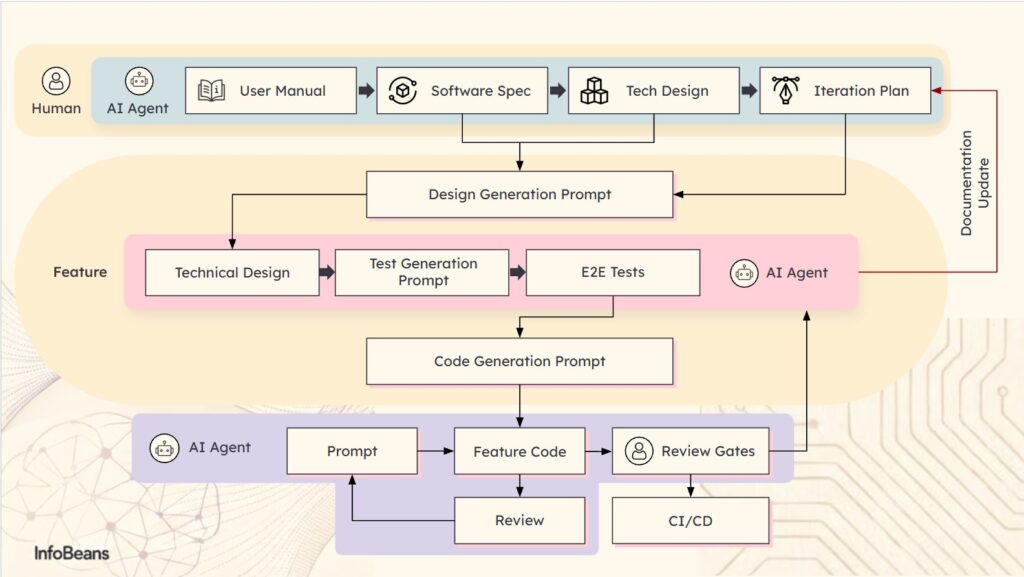
This isn’t theory; it’s battle-tested across greenfield and brownfield projects, blending SDD’s rigor with AI’s efficiency.
Conquering Chaos: Early Wins That Compound
SDD’s core strength? Forcing clarity before commits. Loose requirements lead to expensive UAT surprises; precise specs flip that script. AI supercharges it by generating drafts and spotting gaps humans miss.
- Accelerate delivery: Eliminate rework cycles early. Across our programs, this means faster time-to-market, higher deployment frequency, and lower change failure rates. Every hour in specs saves days downstream; up to 50% faster cycles overall.
- Shift risk left: Traditional models bury issues in QA or production. We surface them in spec reviews: Architectural mismatches? Security as design constraints? Integration deps? All flagged cheap. Defects here cost 5-10x less than testing, 30-100x less than prod. In a recent brownfield overhaul, AI-prompted reviews prevented a compliance nightmare.
- Expose false alignment: Verbal chats breed misinterpretations. Specs like “On submit, validate X, call endpoint Y with payload Z, return A/B/C” force precision. Result: Up to 50% fewer mid-sprint changes and smoother cross-functional handoffs.
Think of it as a GPS for your project. AI provides real-time reroutes to avoid dead ends.
Building for the Long Haul: Sustainability in Complex Systems
Software isn’t a sprint; it’s a marathon. SDD preserves intent, but AI makes it scalable, reducing tribal knowledge and enabling safe evolutions.
- Prevent silent reversals: Long-lived systems regress when “why” is forgotten. Our specs document rationale (e.g., “Rate limit for DDoS compliance”). AI tools like Code Rabbit scan for regressions during refactors, yielding up to 50% fewer bugs and safer enhancements years later.
- Speed up onboarding: In legacies, devs waste weeks decoding code. Clear specs + AI summaries cut that by up to 50%; new hires contribute by week two. Vital for our distributed enterprise teams.
- Reduce dependencies and cognitive load: Specs with API contracts let teams parallelize across frontend, backend, QA, and DevOps, slashing cross-team blocks by up to 50%. Engineers offload mental overhead to artifacts, focusing on innovation over context hunts.
We’ve seen 30-40% faster recovery from transitions, lowering bus factor and boosting long-term maintainability.
Elevating Quality and Predictability: From Guesswork to Precision
Ambiguity kills estimates; SDD concretes scope. AI automates the grunt work, embedding acceptance criteria, error handling, and NFRs.
- Quality at source: Shift from late testing to spec-driven dev. Code reviews speed up to 50% (objective conformance checks), test coverage jumps 30%.
- Better predictions: Teams report 20-25% improved estimation accuracy, 30-40% sprint reliability. Bottom-up reasoning replaces intuition, with fewer surprises.
- Negotiation space: Pre-code reviews evaluate trade-offs such as “Simpler alternative? Architecture fit?”, boosting business-engineering alignment by 50%.
In complex programs, this sustains velocity without burnout.
The Real Magic: A Cultural Shift Where Humans Think, AI Executes
At InfoBeans, SDD embodies a mindset: Specs aren’t overhead, they’re the work that prevents building the wrong thing fast. By fusing engineering precision with product thinking (echoing PRDs, design docs, and lean streams), our Insane SDD Accelerator aligns business intent, UX, architecture, and delivery upstream.
The outcomes? Insane: 50% gains in speed, quality, and onboarding; material cost reductions over time. It’s not just a process, it’s empowerment in the AI era.
Ready to unleash this in your world? Contact us for a tailored demo. We’ll understand your needs and craft insane results with our accelerator. Let’s chat!

Related content

Expona
Context-trained AI agent delivering noise-free, cost-efficient conversational intelligence


Managed support
We offer functional, technical, and implementation support, minimizing disruptions to your operations.
Agentic AI
AI or Gen AI, consulting, development or model building. You ask for any of them. We will deliver.



Stay up to date with InfoBeans
Insights from our team of experts who deliver digital software day in and day out.
 Thank you for signing up!
Thanks a lot for your interest. You are already a subscriber. You will receive your first newsletter soon.
