


The Claude Platform, from Messages API to Multi-Agent Systems.
Build the mental models behind production-grade deployments.
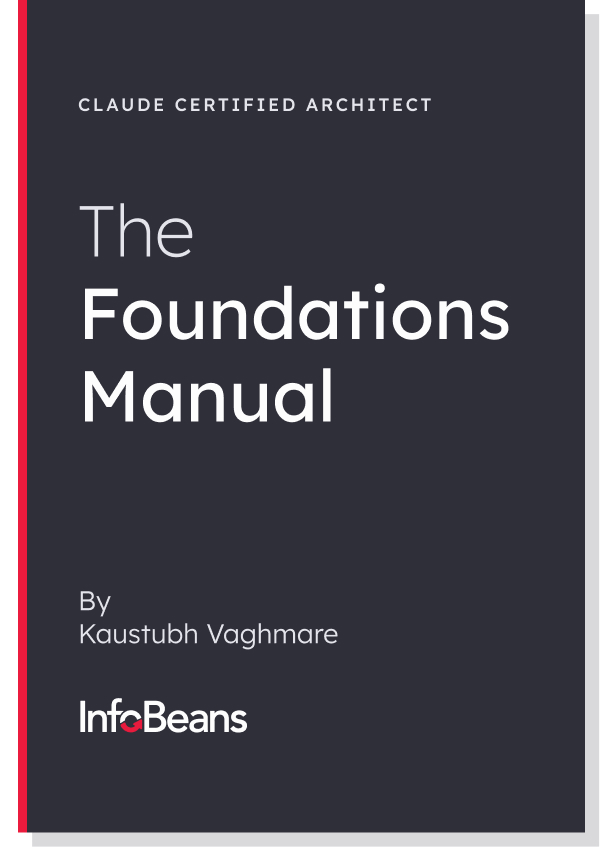
Learn to reason through the Messages API, MCP, Agent SDK, and Claude Code with the practitioner’s guide by Kaustubh Vaghmare, PhD. Built for solution architects and senior engineers preparing for the CCA-F exam and scaling multi-agent systems.
- Verified Partner Resource
- 16 Core Chapters
- 48 Exam Scenarios
- 100% Code-Grounded
Research shows 80% of Enterprise AI projects stall between Sandbox and Production.
Here’s how to ensure your Claude implementation isn’t one of them.
The Architectural Friction:
LLM systems fail in production not from model limits, but from orchestration breakdown. This guide teaches architectural discipline under real-world pressure.
| Production Failure Point | Conventional Approach (Fails at Scale) | Enterprise Standard (Inside the Book) |
|---|---|---|
| Agentic Loop Drift | Prompt instructions alone to enforce tool sequencing | Programmatic enforcement via PreToolUse / PostToolUse orchestrator hooks. |
| Silent API Failure | Blind retries causing thundering herds & rate limit lockouts | Exponential backoff with jitter, is_error taxonomy, & cycle detection |
| Context Exhaustion | Resending growing message histories until token budgets break. | Hierarchical context hygiene, CLAUDE.md scoping, & state scratchpads. |
| Unreliable Tool Execution | Thin descriptions forcing models to fabricate values. | Grammar-constrained sampling, strict tool use, & nullable types. |
Mapped
directly to the
5 weighted
domains of the
CCA-F Exam
-
27%
Agentic Architecture & Orchestration
Determinism, loop mechanics, stop_reason governance, and handoffs.
-
18%
Tool Design & MCP Integration
JSON Schema design, Client vs. Server tools, and MCP primitives.
-
20%
Claude Code Configuration & Workflows
CLAUDE.md hierarchy, Skills, path-scoped Rules, and subagent isolation.
-
20%
Prompt Engineering & Structured Output
Explicit criteria, JSON Outputs vs. Strict Tool Use, and XML tagging.
-
15%
Context Management & Reliability
Exponential backoff, error taxonomy, cycle detection, and escalation.
Core technical capabilities
covered across all 16 chapters
Chapters Covered:
- Ch 1: Platform Overview & Model Families
- Ch 2: Messages API & State Reconstruction
- Ch 3: System Prompts, XML & Prompt Chains
- Ch 9: Streaming Mechanics & SSE Events
Core capabilities:
API fundamentals, prompt engineering, state management, prompt chains, and SSE.
Chapters covered:
- Ch 4: Tool Use & Parallel Execution
- Ch 5: Structured Output & Strict Tools
- Ch 8: Multimodal Input & Files API
- Ch 15: Model Context Protocol (MCP)
Core capabilities:
Tool integration, structured outputs, multimodal vision, file handling, and MCP protocol.
Chapters covered:
- Ch 6: Building Agentic Loops
- Ch 7: Failure Design & Programmatic Hooks
- Ch 14: The Anthropic Agent SDK
- Ch 16: Claude Managed Agents Runtime
Core capabilities:
Agentic loops, failure handling, programmatic hooks, SDKs, and managed runtimes.
Chapters covered:
- Ch 10: Claude Code CLI Foundations
- Ch 11: Session Context & Claude.md
- Ch 12: Subagents & Context Isolation
- Ch 13: Team Workflows, Hooks & CI/CD
Core capabilities:
Claude Code CLI, session context, subagent isolation, team workflows, hooks, and CI/CD.
16
Complete Chapters
A step-by-step pedagogical journey to build mental models for reasoning about GenAI systems.
48
Exam Scenario Items
Multiple-choice items with distractor logic for pre-exam audit.
100%
Python SDK Grounded
Production code for Messages API, Agent SDK, and MCP servers.
Meet the author
Kaustubh Vaghmare, PhD, is Principal AI Architect at InfoBeans. Facing fragmented API documentation and abstract guides, he codified a unified mental model for building, scaling, and certifying production-grade Claude applications — the foundation this manual is built on.
InfoBeans is an official Claude Certified Partner, accelerating enterprise adoption of Anthropic technologies with secure, high-velocity multi-agent systems.

Kaustubh Vaghmare
Principal AI Architect
Access the complete Claude Certified
Architect Manual
Fill out the form to receive your complimentary PDF copy directly in your inbox.